

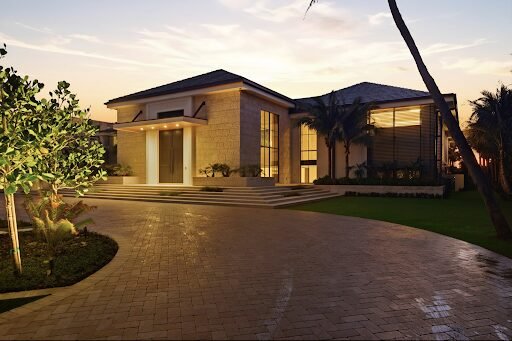
In May 2026, Open Homes Photography published something unusual. They announced a complete overhaul of their virtual twilight service and in doing so, openly acknowledged that the old version was flawed. Not just theirs. Industry-wide.
The core admission was specific: previous twilight photo editing treated sky replacement as the primary edit and left everything else walls, windows, landscaping lit as if it were still midday. The result was a twilight sky pasted over a daytime photo. Not a twilight photo.
That’s a remarkably honest statement from a major photography company. It’s also an accurate description of what most first-generation twilight photo editing looked like.
Why First-Generation Twilight Photo Editing Failed
To understand what went wrong, it helps to understand what actually happens at dusk.
When the sun drops below the horizon, light doesn’t just disappear from the sky. It changes direction and temperature. Shadows shift. Surfaces that were lit from above start catching ambient sky light from the east. Windows begin to glow from interior lighting rather than reflect exterior daylight. Landscape lighting and porch lights activate. The whole scene rebalances.
First-generation twilight photo editing handled exactly one part of that process: the sky. An editor would select the original sky, drop in a sunset or blue-hour replacement, adjust the hue and saturation of the image and call it done. The problem was visible in every output that wasn’t scrutinized carefully: the tree line had a halo from the sky swap.
Buyers who knew what to look for saw it immediately. And buyers who couldn’t articulate why it looked off just felt that something was wrong.
What Modern Twilight Photo Editing Does Differently
The AI-trained approaches to twilight photo editing that have come to market since 2024 work differently because they were trained on real twilight bracket data, actual photos taken at dusk, not daytime photos modified by hand.
That training changes what the model knows to adjust. Window interior color temperature gets warmed to match realistic interior lighting. Shadows are adjusted to match the implied direction and softness of evening ambient light. Landscape lighting and exterior lights are elevated to reflect their natural illuminated state at dusk. Sky gradients are placed to match the actual horizon relationship of the property.
The result is that a well-executed twilight photo editing process now changes the whole scene, not just the sky panel.
The three things that still expose a bad twilight photo editing job haven’t changed: harsh masking edges where sky meets tree foliage, interior windows glowing the wrong color temperature and sky gradients so saturated they read as theatrical rather than real. When those three things are handled correctly, buyers don’t notice they’re looking at an edited image. They see a house at dusk.
The Practical Standard: What to Look For in Output Quality
Whether you’re evaluating twilight photo editing services or assessing your own outputs, these are the specifics worth checking:
Tree and roofline edges
The boundary between the sky replacement and the property’s silhouette should be clean and natural. Haloing, soft blending or visible masking artifacts are the most common failure point.
Window interior temperature
At true dusk, interior lights produce a warm amber glow roughly 2700K to 3200K color temperature. If window interiors look white, cool or unnaturally bright relative to the sky, the edit isn’t finished.
Shadow direction and softness
Evening ambient light produces long, soft shadows. Hard shadows that match a midday sun angle don’t belong in a twilight image.
Sky gradient believability
The sky at dusk darkens upward from the horizon. Gradients that are uniformly saturated or that don’t darken toward the top read as artificial.
AutoHDR handles the core editing pipeline sky placement, window masking, white balance, camera reflection removal and straightening as the base that every image goes through before twilight photo editing is applied. The quality of the base edit directly affects how convincing the twilight output looks.
When Real Twilight Still Makes More Sense
No twilight photo editing output fully replicates what a camera captures during actual blue hour on the right evening. Real twilight has organic light falloff, genuine pool and landscape light interaction and a sky gradient that’s specific to that date, that location and that atmospheric condition.
For luxury listings where premium photography is part of the marketing value properties above $1.5M, architecturally significant homes, properties with dramatic exterior lighting a real twilight shoot is still worth the second trip.
For standard residential listings where the goal is a better hero exterior shot, a well-executed twilight photo editing process delivers a result buyers respond to without requiring a return visit.
Final Thoughts
The public acknowledgment from Open Homes Photography that first-generation twilight photo editing was broadly broken is useful for the industry. It names the problem clearly. Photographers and agents who understand what separates the old approach from the current one are better positioned to evaluate quality, set expectations and deliver output that holds up when buyers look closely.